

What Network Maps Reveal That Org Charts Never Will
Organizations are designed with clean lines. Roles, responsibilities, reporting structures: everything arranged to communicate accountability and intention. When a new product launches, when a restructure happens, when a technology platform gets replaced, the org chart updates to reflect it.
But the informal network doesn't work that way. It evolves on its own terms, shaped by trust, history, habit, and proximity. It predates the latest reorg. It often outlasts the next one. And when something in an organization stops working, the answer is almost never in the boxes and lines. It's in the informal connections that never appeared on any chart to begin with.
We hear some version of the same thing from heads of talent across industries: organizations know they have a collaboration problem. They feel it. But it never fits cleanly into a budget line, and no single function owns it. Everyone agrees something needs to change. Nothing moves. That's usually because they're solving for the symptom, not the signature. After reading hundreds of network maps, three patterns show up in nearly every organization that is struggling to execute. They're not always obvious at first. Once you know what to look for, they're hard to miss.
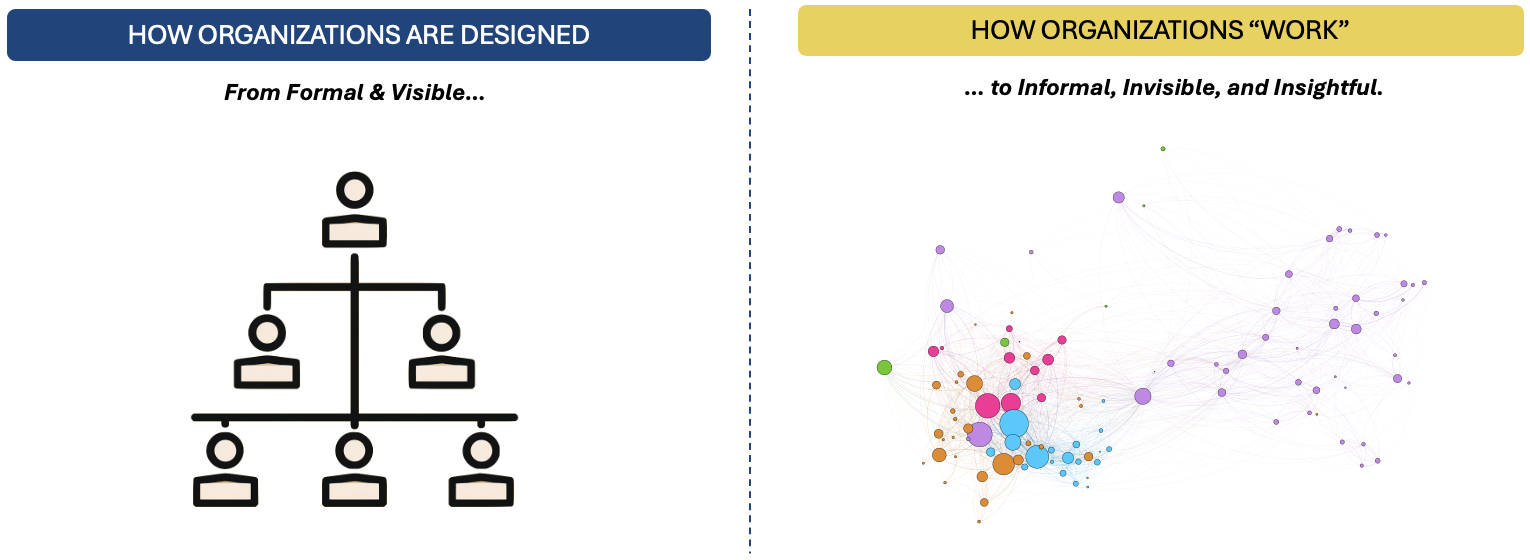
Side-by-side comparison of a formal org chart on the left and an organizational network map on the right, illustrating the difference between how organizations are designed and how they actually operate.
Where Leadership Sits in the Network
This is not about whether leaders are "connected" in any social sense. It's about whether their position in the informal network reflects what the organization actually needs from them.
The diagnostic questions we ask are straightforward. Does leadership connect with each other? Do people in the organization actually get what they need from them? And is there a feedback loop running in both directions?
We worked with a healthcare organization that had two distinct medical practitioner groups operating under the same umbrella. One group was functioning well. The other, the behavioral health vertical, was struggling in ways that leadership couldn't fully explain. The network map made it visible quickly: a heavily structured communication flow, a high percentage of employees routing directly to the vertical's CEO, and almost no path for frontline information to travel upward. Front-line escalations were constant. The pace of change was stifled. The leadership style assumed that control and hierarchy were the appropriate mechanisms for this environment. The network showed exactly what that assumption was costing.
A different version of the same signature appeared in a brokerage firm we worked with. Leadership held essentially all the information, all the client relationships, and all the meaningful decisions. Eighty-three percent of the organization was regularly seeking out their leaders for information, context, or direction. There was almost no bottom-up feedback reaching the top. It worked, in its way, until the firm needed to pursue increasingly complex cross-market client opportunities. At that point, everyone seemed to agree on the direction. Nothing happened. The network had been structured around dependency for so long that the organization had no muscle for lateral coordination.
"When 83% of an organization is routing to the top for information, that's not leadership. That's a structural dependency."
The two cases look different on the surface, but the signature is the same: a leadership layer that became a ceiling rather than a conduit. Understanding which version you're dealing with is what determines where to start.
Who Is Controlling the Information Flow
People often assume this answers the same question as leadership position. It frequently doesn't. Critical information hubs can appear anywhere in an organization, far from the top, and they tend to go unnoticed precisely because the people involved are doing their jobs well.
At a credit card company, the network analysis surfaced a compliance officer who sat at the center of an enormous proportion of cross-functional information flow. This wasn't a leadership failure or a management oversight. It was a feature of how the business was structured: compliance had to touch everything, and over time, one person had become the de facto channel for almost all of it. The work starts by understanding what people are actually bringing to that person, and why. Sometimes the answer is adding capacity. Sometimes it's making key information more accessible so not every question needs to route through a single approver. Sometimes it's updating the decision guardrails so fewer things require a sign-off at all. The individual isn't the problem. The load they're carrying is.
A technology firm we worked with had made a services arm the centerpiece of its growth strategy. Years in, the initiative wasn't gaining traction. When we mapped the network, the reason became clear: a single individual was responsible for ninety percent of all information flow between the services team and the sales team. Everything that needed to move between those two functions moved through that person, or it didn't move at all.
"One person. Ninety percent of the information flow between two teams. That's not a connector. That's a single point of failure."
Rapid growth and significant change produce the same pattern through a different mechanism, and we see it especially in startups moving away from a founder-led model. In the uncertainty that follows, employees begin informally rallying around certain individuals to shoulder the information load, whether because of their tenure, their relationships with leadership, or their experience in a particular area. The network concentrates around them gradually, and by the time it's visible in performance data it has usually been building for quite a while.
Where the Siloes Are, and Whether They Matter
Not all siloes are a problem. Some are functional. Some are intentional. The diagnostic question is whether they are by design or by accident, and whether the organization can afford them.
The framing question we start with is: who should be at the center of your network map? The answer isn't always the CEO, especially if their role is primarily external-facing. From there, the question becomes: given the strategy, who actually needs to be coordinating with whom? That answer tells you which siloes are acceptable and which ones are costing you something.
A CPG organization we worked with had a structural tension baked into its operating model. Sales was incentivized to push SKUs. Operations was incentivized to control costs. Those priorities were structurally antagonistic, and leadership knew it. They had set up a dedicated interlocking team specifically to bridge the two functions. When we mapped the network, we found that the bridge team itself was completely siloed internally: its members were not sharing connections, context, or lessons learned with each other. They had each built individual relationships across the divide, but those relationships weren't compounding. The bridge team wasn't bridging.
Another organization we worked with had spent years on serious integration work following a period of substantial M&A activity. When we mapped the combined organization, the most significant siloes still ran through the legacy companies. Different priorities, different cultures, different institutional languages all meant that even with shared strategic goals on paper, every team was effectively running its own playbook. The formal integration had happened. The informal network had not followed.
"The question isn't whether siloes exist. Every organization has them. The question is whether your siloes are costing you something you can't see yet."
The So What
These three signatures don't tell you what to do. They tell you where to look.
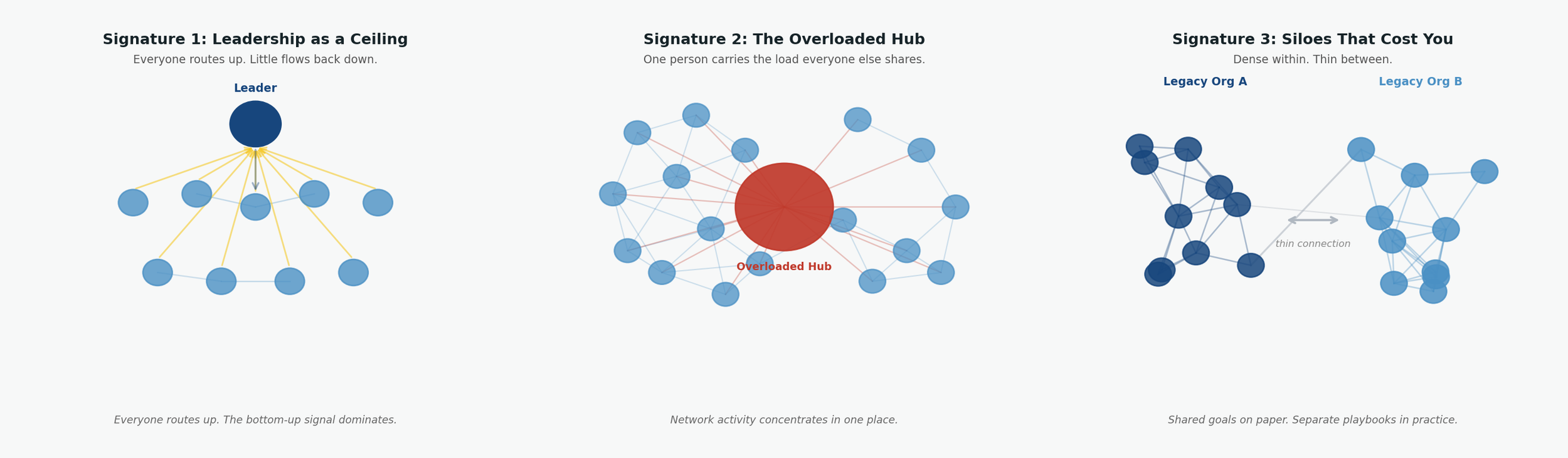
Three schematic network diagrams illustrating common organizational patterns: leadership bottlenecks, overloaded hubs, and siloes.
The value of reading a network map isn't the map itself. It's the conversation it forces: is what we're seeing here by design, or did it happen while we weren't paying attention? And if it happened while we weren't paying attention, what has it been costing us?
Most organizational diagnostics tell leaders what's wrong. The network map tells you where it started.
About the Author
Victor Bilgen is the Founder of BridgeLayer Analytics. He spent 13 years at the McChrystal Group running diagnostics and network analysis for Fortune 1000 executives, and built BridgeLayer because the gap between organizational insight and organizational action kept showing up in the same place: the work that comes before the recommendations. He is a contributing author to The Social Capital Imperative (Oxford University Press, 2025).
