

The Hidden Architecture of AI Adoption
Most organizations pushing for AI adoption are making the same structural mistake. They identify the problem correctly: tools are underused, adoption is inconsistent, the business case is eroding. And then they hand the solution to their traditional hierarchy.
The CHRO sends a message about strategic importance. A senior VP becomes the executive sponsor. Managers are tasked with driving adoption on their teams. The initiative lands on the next all-hands agenda.
And yet adoption remains uneven. The tools get used by the people who were always going to use them. Everyone else waits to see whether this is real or just another initiative that quietly fades.
The hierarchy is not the wrong place to start. It is the wrong place to stop.
Refining the Picture
There is a framework that explains why most AI transformation programs underperform. It starts with a diagram most change management teams never draw.
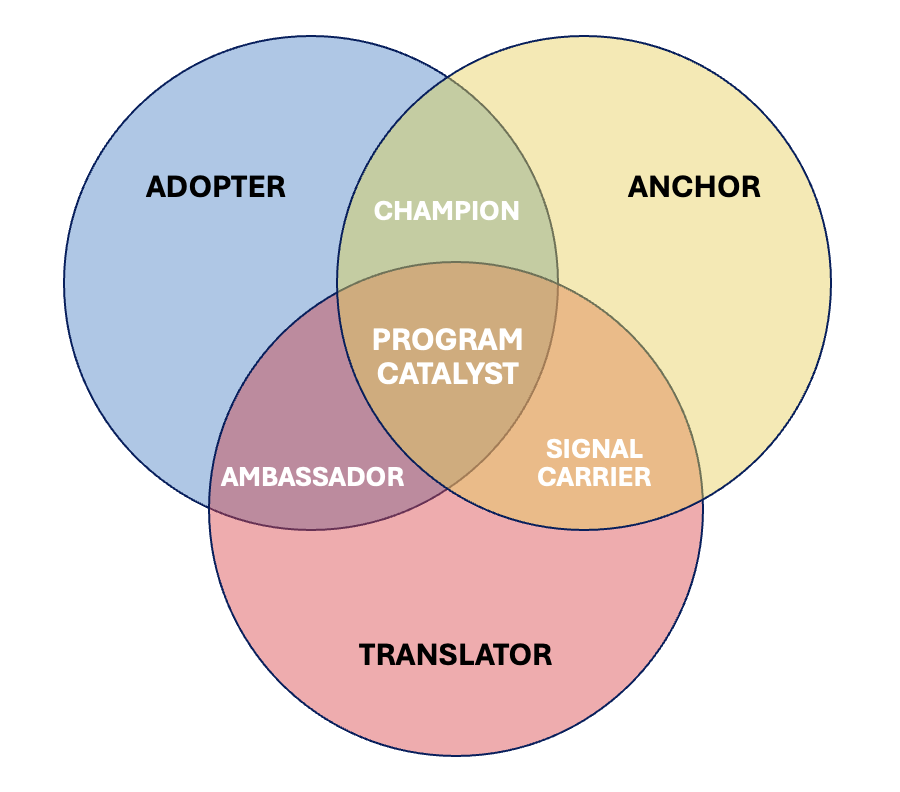
Three overlapping circles. Each representing a critical segment of your transformation efforts.
The first is your Adopters: people who have the organizational conditions and the behavioral signals to actually use AI. The other two describe your influencers. Anchors are densely connected within their immediate network, the people whose judgment others rely on before forming their own opinion. Translators are connected across functions, regions, or levels, the bridges that move information between groups that don't naturally interact.
Where Adopters and Anchors overlap, you have Champions: people who are ready to use the tools and are trusted by their immediate cluster to validate whether this is real.
Where Adopters and Translators overlap, you have Ambassadors: people who are ready to use the tools and can carry that signal across organizational boundaries.
Where all three overlap, you have Program Catalysts: the rare individuals who combine personal readiness, deep local trust, and cross-functional reach. Finding even two or three of them can change the trajectory of an entire rollout.
The reason most programs default to assigning change agents by title or enthusiasm is that the other two circles are invisible without data. That's what this piece is about.
Who Are Your Adopters?
Identifying adopters requires looking through two lenses at the same time.
The first is behavioral. Current tooling can tell you a great deal. Microsoft's research on enterprise AI deployment has tracked adoption curves across organizations for years. The pattern that emerges consistently distinguishes early heavy users, early light users, late adopters, and those who disengage entirely. If your organization has been running an AI tool for six months or more, that usage data already exists. Who is using it frequently, and for what? Who tried it once and stopped? Where is it embedded in daily workflow versus where is it treated as a side experiment?
The second lens is structural. Behavioral adoption data tells you what is happening. A diagnostic assessment tells you why. The conditions that predict whether someone can sustainably adopt AI are not primarily about technical skills. They are about organizational conditions: whether someone has clarity on what AI means for how they do their job, whether they have the decision autonomy to experiment and change their approach, and whether their personal goals are aligned with where the initiative is headed. The people with strong behavioral signals and strong structural conditions are your most reliable adopters. One without the other tends not to hold.
Who Are Your Influencers?
This is the harder question, and it is where most programs go wrong.
When change management teams need influencers, they typically ask managers to nominate people, identify high performers, or find volunteers. The problem is that none of those methods measure informal network position. They measure visibility and enthusiasm, which sometimes overlap with influence, but often don't.
Research from Michael Arena at the Process Excellence Network, drawing on data from Microsoft's HBR study, makes this specific: employees are roughly twice as likely to adopt AI when their leaders use it, but nearly three times as likely when a trusted colleague does. Among top-quartile AI users, 88% described their local peers as highly influential in their decision to adopt. Among bottom-quartile users, that figure dropped to 50%. The gap in adoption between those two groups was not a training gap or a tools gap. It was a peer trust gap.
That peer trust is what Anchors and Translators carry.
Anchors are densely connected within their immediate network. They are the people others check with before forming an opinion. Tenured experts, people in uniquely critical roles, individuals whose reputational capital has accumulated over years. Not every senior leader is an anchor, and not every anchor is senior. The network data tells you who actually is.
Translators are connected across functions, regions, or levels. They sit between groups that don't naturally interact. They may not be named as the most influential person within any single team, but they move information across boundaries that others can't reach. They are often shaped by cross-functional career paths, project histories, or simply the kind of relational range that makes them the person who doesn't eat lunch alone.
The distinction matters because they serve different functions in an adoption rollout. Anchors validate. Translators connect. You need both, and you need them in the right sequence.
The Three-Circle Diagnosis
The reason this framework holds up in practice is that each combination of circles produces a different kind of leverage.
A high-performing adopter with no informal influence will change their own behavior and not move anyone else. They are valuable for generating usage data and refining use cases, but they are not change agents.
An anchor or translator who lacks the structural conditions to adopt will send a signal to everyone watching them. The signal will not be what you hoped. When a trusted informal leader visibly disengages from an initiative, even quietly, it gives their network permission to do the same. This is one of the more underappreciated risks in change management: informal influencers who are not set up to succeed can do more damage than formal skeptics.
The overlap is where the leverage concentrates. Champions can shift the immediate cluster around them. Ambassadors can move adoption across organizational lines. Program Catalysts can anchor both.
Finding them is not a nomination process. It is a data process. Running a structured behavioral assessment alongside a network survey produces a map that most change management teams have never seen: a picture of who is ready, who is trusted, and where those two populations intersect.
What This Looks Like in Practice
A large CPG company invested in a major AI program across three of their main business units. After six months, leadership wanted to understand why adoption looked so different across teams.
The numbers were stark. One business unit hit 40% of licensed employees showing significant, sustained AI adoption within two months. The other two teams lagged significantly through months four and five. The tools were identical. The training was the same. The expected access and resources were consistent across all three units.
The difference came down to the conditions set by leadership in that first unit. Their leadership team had established visible, consistent buy-in early. The change management rollout had been carefully designed with explicit attention to identifying and enabling informal change agents before the broader launch. The result was a peer trust environment that the other two units had not yet built.
After taking those conditions into account and being more deliberate about identifying champions and ambassadors across all three business units, the teams were able to build consistent adoption plans and saw major spikes in AI use across all three groups over the following quarter.
The technology did not change. The targeting did.
Identify, Engage, Enable
The practical application of this framework follows a sequence.
Identify runs two tracks in parallel. The first is a behavioral and structural assessment that surfaces who has genuine readiness to adopt, not just stated willingness. The second is mapping the actual flow of trust and information in the organization, identifying who the informal anchors and translators actually are. The overlap between those two outputs is where you focus your program investment.
In most organizations, some of the people with the highest informal influence sit two to three levels below senior leadership. They are team leads, tenured individual contributors, subject matter experts whose judgment colleagues have learned to trust over years. They are almost never on a nomination list. The network map is how you find them.
Engage means bringing these people in before the rollout, not after. Not to pre-sell. To pressure test. Anchors validate: if a concept doesn't resonate with them, it won't land with their network. Translators connect: give them a problem to help solve across groups, not a message to broadcast. Co-ownership travels further than endorsement.
This requires a different orientation than standard change management. Champions and ambassadors are not communications targets. They are co-designers. The distinction is real, and people inside organizations can feel it immediately.
Enable is where most change programs fail. Organizations identify the right people, brief them once, and then leave them without the support to actually do the work their network position requires. Champions and Ambassadors need dedicated time. This work is not free on top of a full role. They need access to resources that let them answer peer questions without escalating every conversation back to the project team. And they need visibility: when a champion's adoption is publicly recognized, it sends a signal to their network that the program is legitimate and that the people who matter have committed to it.
There is also a risk worth naming here. The more you rely on the same anchors and translators, the more load you concentrate on the people who are least likely to say they are overwhelmed. The goal is not to extract from the influencers you already know. It is to build more of them over time, and to make sure your organization is not held together by people who cannot afford to leave.
The Diagnostic Question Underneath This
This three-circle model is a practical tool. It is also a diagnostic signal about something more structural.
If your AI transformation is stalling, the first question is not "how do we communicate better?" It is: do we know who the informal leaders in this organization actually are?
In most organizations, the honest answer is no. Change programs over-invest in formal channels and under-invest in the human networks that determine whether anything actually changes. Mapping the informal organization is not a soft exercise. It is a structural precondition for durable transformation. The adopter-influencer overlap is one of the most direct ways to apply that mapping to a concrete, measurable outcome.
About the Author
Victor Bilgen is the Founder of BridgeLayer Analytics. He spent 13 years at the McChrystal Group running diagnostics and network analysis for Fortune 1000 executives, and built BridgeLayer because the gap between organizational insight and organizational action kept showing up in the same place: the work that comes before the recommendations. He is a contributing author to The Social Capital Imperative (Oxford University Press, 2025).
