

Engagement Surveys Locate the Symptom. They Rarely Locate the Cause.
Organizations run engagement surveys once a year. Some run shorter pulse checks more frequently. Either way, the results follow a familiar pattern: executives get a report card. Line managers get a list of action items.
That structure is deliberate. The assumption built into most engagement programs is that the problem lives at the manager layer. When engagement dips, managers are asked to communicate better, build more trust, and develop their people. Fix the managers, fix the scores.
That assumption is incomplete. And the survey is designed in a way that makes it difficult to see what is missing.
Engagement Still Matters
Before going further, it is worth being clear: engagement is a legitimate and important measure. The research is compelling. Microsoft's Work Trend Index, drawing on data from more than three million employees across 226 public organizations, found that companies with the most engaged workforces outperformed the S&P 500 after one year. Each additional point of employee-reported engagement correlated with a $46,511 difference in market capitalization per employee. Engaged employees are more productive. Productive employees become more engaged. The relationship is mutually reinforcing.
The argument here is not that engagement surveys are wrong to run. It is that a number, even an accurate number, does not tell you where the problem starts.
The Score Points Down. The Cause Often Lives Upstream.
An engagement score tells you that something is off in a team. It tells you the magnitude. In some cases it tells you which dimension: trust, clarity, inclusion, development.
What it cannot tell you is whether the manager is the cause, the symptom, or someone doing their best with the wrong inputs.
That distinction matters more than most engagement programs account for. A manager cannot credibly guide their team through a strategic shift they have not been clearly given themselves. They cannot build alignment around priorities that have not cascaded from above. They cannot project confidence in a direction that the leadership above them has not made legible.
When engagement drops at the team level, the survey points down. The real question is whether you should also be looking up.
What the Data Actually Showed
In one organization I worked with, we ran an engagement survey and an organizational network analysis together. The network analysis asked employees to name who they actually went to for leadership and mentorship, not who they were assigned to, but who they genuinely sought out.
One finding reframed everything else. Employees who named their direct manager as a leader or mentor scored significantly higher on organizational trust than those who did not. The gap was not marginal. The manager relationship was functioning as the primary channel through which employees interpreted organizational health.
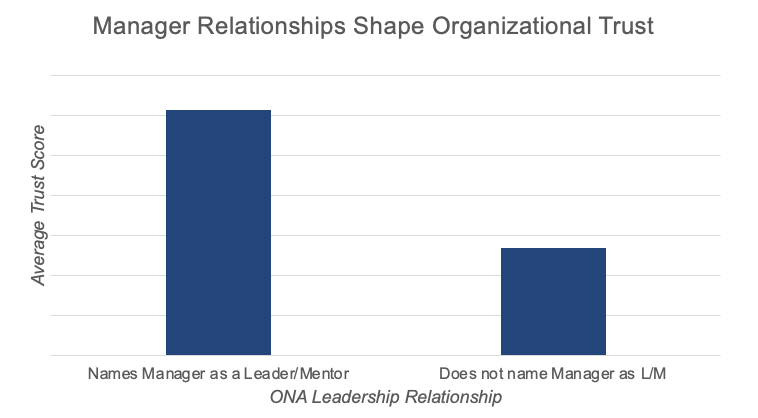
Employees who named their direct manager as a leader or mentor scored meaningfully higher on organizational trust than those who did not.
Source: BridgeLayer Analytics client engagement and network analysis.
The next question was: why were so many employees not naming their manager?
When we looked at where people were going for strategic direction, 64% of all nominations went to VP-level leaders and above. Only 3% went to direct line managers. The management layer was being bypassed, not because managers were absent or ineffective, but because the strategic clarity they needed to lead their teams had not reached them. People were going around them to get to the source.
The engagement scores were a symptom of that gap. Managers were being held accountable for team trust and prioritization while operating without the direction they needed to actually lead. The survey pointed at the managers. The network data pointed upstream.
In some cases the manager accountability frame is exactly right. In many others, the manager is being asked to solve a problem that originated above them, in how strategy was communicated, how decisions were made, and how the organization was structured to carry the work.
A More Useful Question
The engagement survey asks: how do people feel?
The more diagnostic questions are: what conditions are shaping how they feel, and where in the organization do those conditions originate?
Answering that requires knowing how work actually flows. Who do people rely on? Who shapes how they interpret priorities? Where does decision-making slow down? Which parts of the organization are structurally disconnected from the direction being set at the top?
That is not information an engagement survey can surface. It requires mapping the informal architecture of the organization, not how it is supposed to work, but how it actually works.
Execution readiness, the set of conditions that determine whether an organization can actually deliver on what it is trying to do, starts at that informal layer. When you have that picture, an engagement score stops being a verdict on a manager and starts being a signal about a system. And the more useful question becomes not how do we improve these scores, but what upstream conditions are producing them, and who in this organization has the authority and clarity to address them.
This piece is part of a continuing series on execution readiness. The next installment applies this framework to AI adoption programs, where the gap between intent and outcome is especially costly.
About the Author
Victor Bilgen is the Founder of BridgeLayer Analytics. He spent 13 years at the McChrystal Group running diagnostics and network analysis for Fortune 1000 executives, and built BridgeLayer because the gap between organizational insight and organizational action kept showing up in the same place: the work that comes before the recommendations. He is a contributing author to The Social Capital Imperative (Oxford University Press, 2025).
